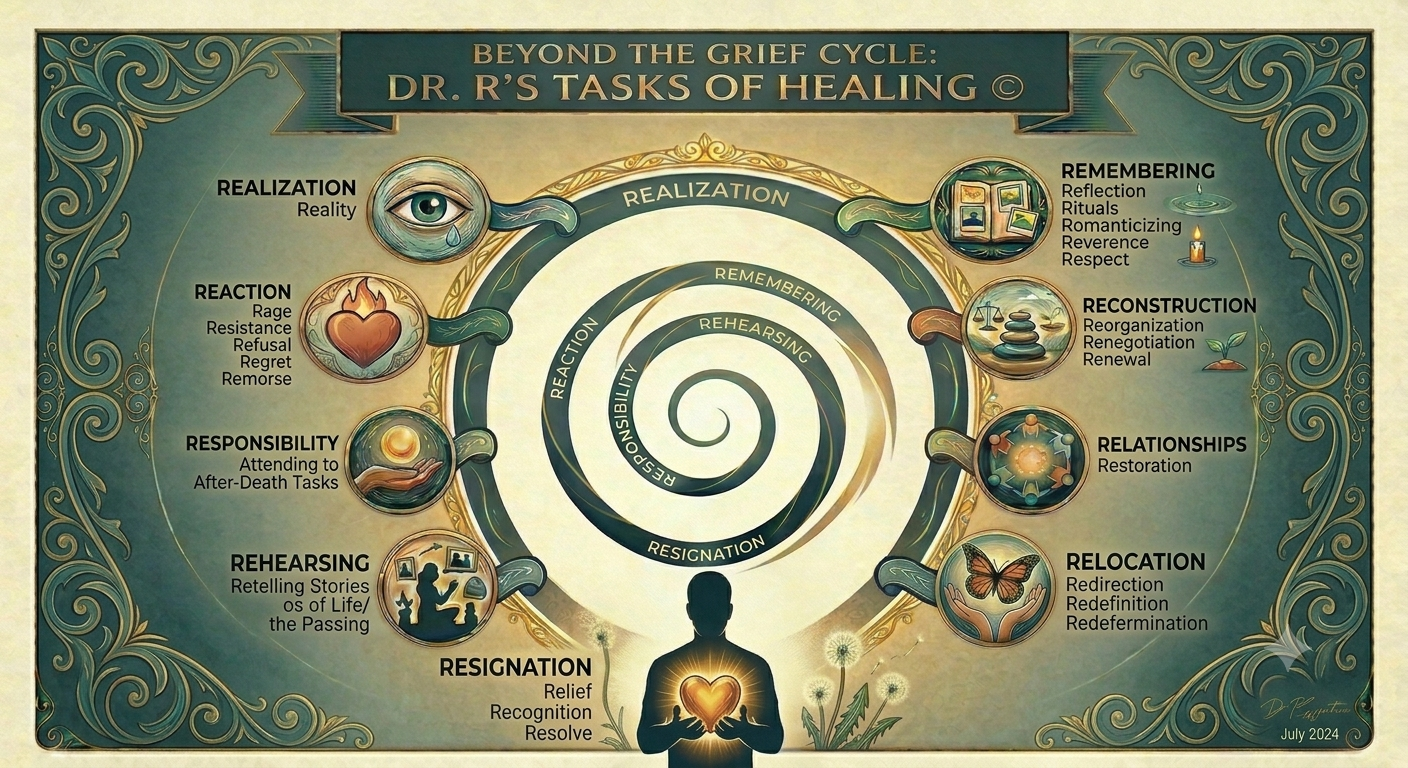
Beyond the Grief Cycle: Dr. R’s Tasks of Healing ©
For decades, the standard vocabulary surrounding loss has been anchored in the familiar Kübler-Ross stages of grief. However, a crucial distinction has been lost in translation: these stages were originally observed to describe the psychological timeline of the dying person facing their own mortality. Erroneously, this framework has been broadly applied to cover the deeply complex and distinct experiences of the bereaved.
While shock and denial are natural reactions, the journey of the survivor demands a much deeper, richer, and more active framework. True healing is not a passive cycle to be endured, but a series of profound evolutions. Through extensive research and hands-on experience at the threshold of life and death, Dr. R’s Tasks of Healing© maps the definitive path that survivors actually undertake to find wholeness after the death of a loved one.
This model reframes the journey from emotional states into nine active tasks:
Realization: The reality of the situation dawns on the person.
Reaction: allowing yourself to feel all of the emotions that you have. These emotions can be wide ranging- from sadness to rage, resistance to remorse.
Responsibility: Attending to the heavy logistical tasks left behind; this task often allows the individual to cope- so don’t demand that the bereaved “sit down” and not work. Action often comforts the bereaved: at least they can do something.
Rehearsing: Healing begins to happen when we grasp the reality of our situation by telling and retelling the stories of our loved one’s lives. this task often includes telling the story of the passing, framing and reframing the situation. Grappling with the raw emotions and trying to reason with the “why’s” and “how’s.”
Resignation & Remembering: Reaching a point of quiet recognition and resolve, which gives way to intentional rituals, reflection, and deep reverence for the deceased.
Reconstruction, Relationships, & Relocation: Reorganizing and renewing one's own life, restoring supportive bonds, and ultimately redefining one's goals/life purposes.
It is critical that we begin to shift our cultural conversation and embrace these terms. By naming these tasks, we give survivors the accurate, compassionate vocabulary they need to navigate, understand, and honor their true journey to healing.
Note: The descriptors under these tasks are not all-inclusive but are, instead, a brief illustration of the task. Copyright July 2024.